Patent · US 10,768,139 B2 · granted 2020
Small wire, big surface: the electrochemical probe patent
How rebuilding the tip of a hair-fine wire with nanostructured gold and a sensing layer lets it hear neurons clearly and be tuned to detect chemistry.
Cancer Neurotechnology Lab
14 October 2026 · 8 min read
Every electrode that touches living tissue faces a trade-off. Make it thinner, and it disturbs the tissue less. But a thinner wire has a smaller tip, and a smaller tip is a worse listener: its impedance rises, signals weaken and noise grows.
US Patent 10,768,139, filed by the Francis Crick Institute with inventors Romeo-Robert Rácz, Mihaly Kollo and Andreas Schaefer, describes a way around that trade-off.[1] Keep the wire very thin, but rebuild its tip with chemistry, so that a tiny tip behaves like a much larger one.
The problem it addresses
The patent explains that as neural sensors are miniaturised, their impedance in salty body fluids rises, signals weaken and noise increases.[1] That forces designers to add amplifier stages, filtering and matching circuitry, which consume power, a critical issue for battery-powered implants. Improving signal strength while keeping electrodes at micrometre scale is, in the patent's words, "of paramount importance".
What the patent describes
The first claim sets out the probe.[1] It is a bundle of wire electrodes lying alongside one another. Each has a conducting core and insulation, a diameter of 25 micrometres or less, and a front end that tapers to a point. On the polished tip sits a layer of metal or metal-oxide nanostructures, each 500 nanometres wide or less, which reduces impedance and does not extend beyond the wire's own diameter. A functionalisation layer sits on top. Along the sides of each wire, the insulation touches the core directly.
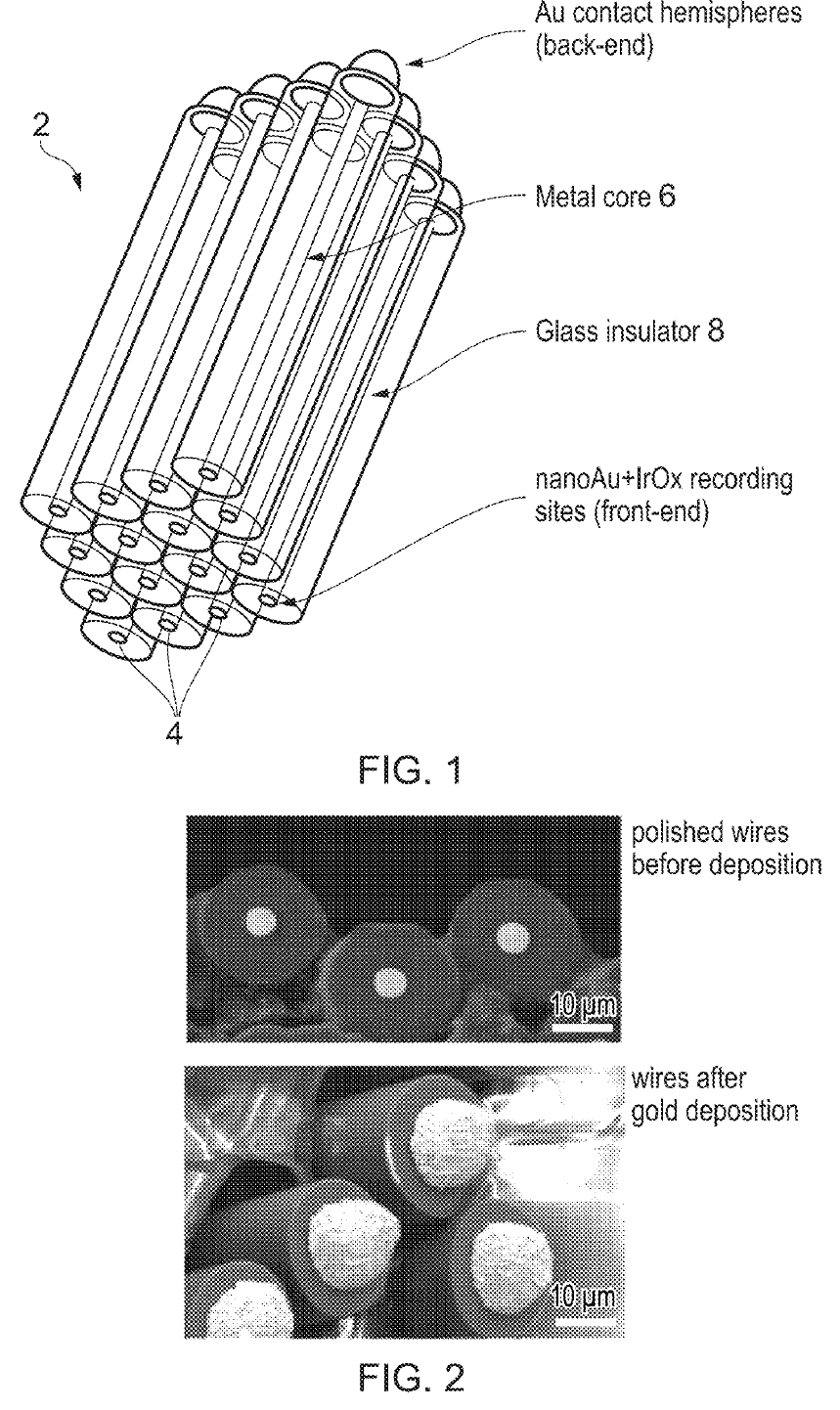
The probe. A bundle of glass-insulated wires (top), with gold contact bumps at the back end and nanostructured recording sites at the front. Below, polished wire ends before and after gold is grown on them.
Drawings reproduced from US 10,768,139 B2 (FIGS. 1 and 2).Further claims cover separate insulating sheaths or a shared insulating matrix; noble-metal and gold nanostructures; a recessed tip with the layers deposited inside the recess; different groups of wires carrying different functionalisation layers; a harness with threads that can steer the bundle's tip; pairing the probe with an amplifier chip; and methods for making it.
Rebuilding the tip
The patent describes a two-step coating.[1] First, gold is grown onto the polished tip as a flaky, highly branched layer of nanostructures, which provides a large surface area for charge transfer. Then a spongy, porous layer of iridium oxide is deposited on top. The patent notes that iridium oxide supports pH sensing, and that its high charge storage capacity helps deliver current for stimulation and to detect substances such as dopamine.
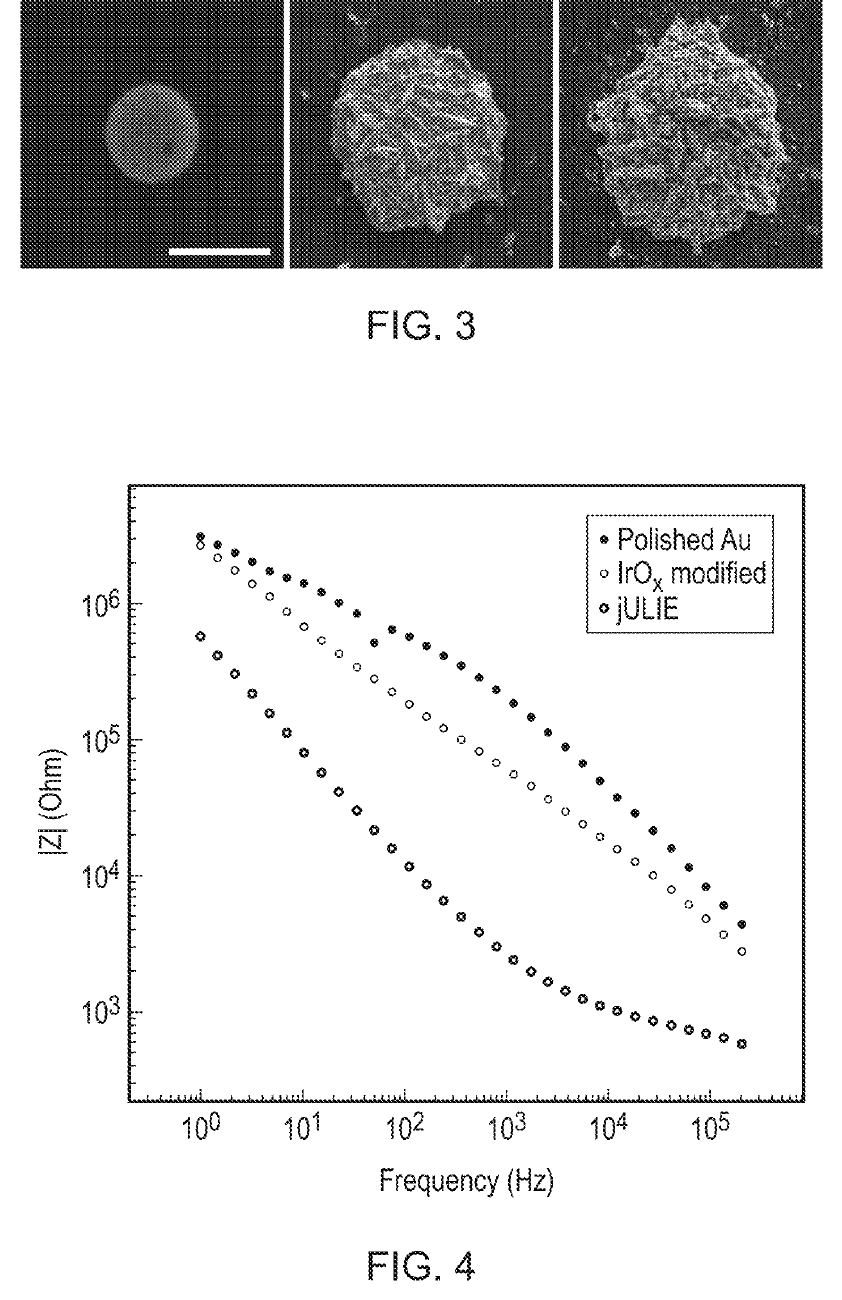
Two layers, ten times lower impedance. A bare tip, the same tip with gold nanostructures, and with iridium oxide on top (upper row). The graph compares impedance across frequencies: tips with both layers, labelled "JULIE", sit about an order of magnitude below the others.
Drawings reproduced from US 10,768,139 B2 (FIGS. 3 and 4).The patent compares three tips: bare polished gold, iridium oxide alone, and the two-layer combination, which it labels "JULIE". The two-layer tip had an impedance about an order of magnitude lower than the other two.
Recording from neurons
To test the electrodes, the inventors recorded in the olfactory bulb of anaesthetised mice aged 4 to 6 weeks.[1] They reliably recorded spikes of up to 1.6 millivolts, and well-isolated signals of 500 to 1,500 microvolts from neurons about 20 to 30 micrometres from the tip. Units could be recorded throughout the olfactory bulb after the probe had been lowered several millimetres and brought back to a shallower position. The patent compares these with recordings from a typical commercially available probe, which show much smaller spikes.
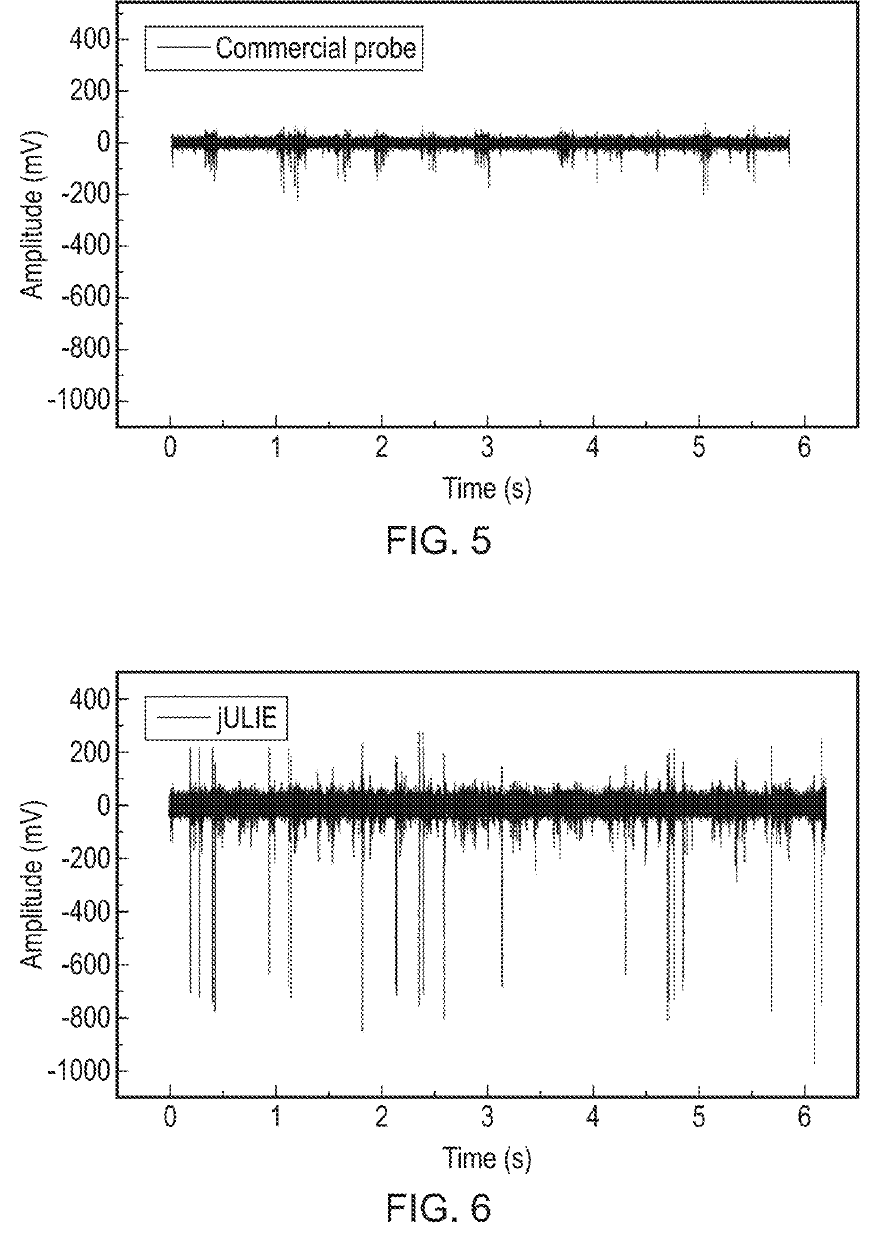
Bigger signals. Neuronal recordings in mouse brain with a typical commercial probe (top) and with the patented probe (bottom), on the same scale.
Drawings reproduced from US 10,768,139 B2 (FIGS. 5 and 6).The patent lists further advantages: penetrating wires 2 to 5 times smaller and recording sites up to 50 times smaller than conventional probes, which it says reduce tissue displacement and improve the separation of signals from individual neurons; and tips that can be sharpened to a needle point.
Connecting to a chip
At the back end, gold bumps are grown on each wire. The patent describes pressing these directly onto the contact pads of an amplifier chip, such as a microelectrode array chip or a CMOS-based potentiostat, with no connector in between.[1] For bundles with more than about 1,000 wires, it notes, wiring each one individually becomes impractical, so direct pressing is the more useful approach.
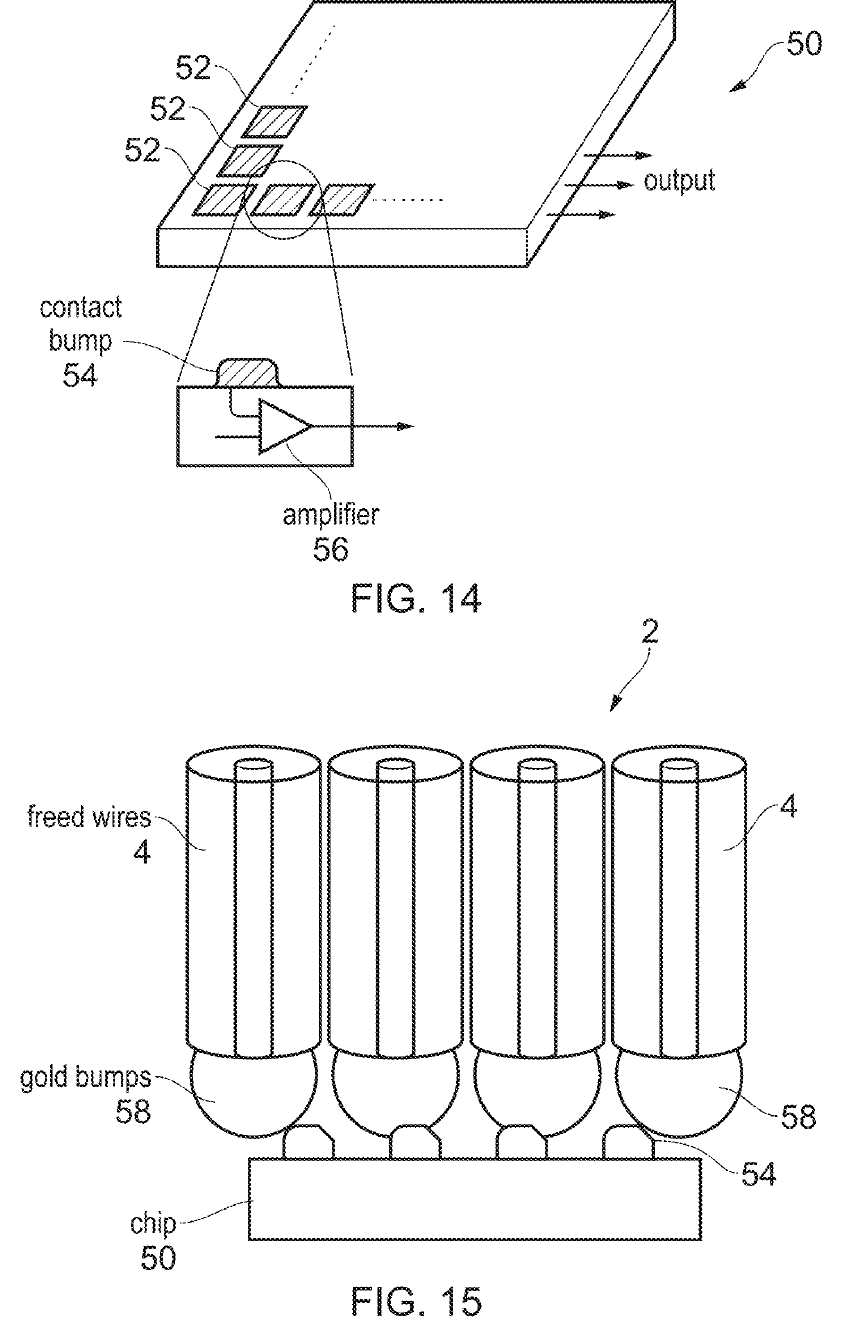
Straight onto the chip. An amplifier chip with a grid of pixel readout circuits (top). Gold bumps on the wire ends press directly onto its contacts (bottom).
Drawings reproduced from US 10,768,139 B2 (FIGS. 14 and 15).This is the same principle that was later tested at scale in the CHIME work, where bundles of hundreds of wires were pressed onto CMOS chips to record from the mouse brain.[3]
One probe, many sensors
Because the gold layer provides a platform for many coatings, the patent describes probes in which different groups of wires carry different functionalisation layers: for example, one group with iridium oxide for pH or electrical signals, another with DNA probes, another with an enzyme to detect alcohol.[1] It lists potential applications including neural recording and stimulation, neurotransmitter detection, pH, glucose, DNA and immune sensing, and scanning electrochemical microscopy. These are described as possible uses, not demonstrated results.
The patent also describes a practical manufacturing aid: a connector filled with a carbon composite that touches every wire end at once, so a bundle with many wires can be coated in a single step without damaging the gold bumps.
What a patent is, and is not
- What it shows. A specific electrode design and how to make it, with measurements of impedance and recordings from the mouse brain reported in the patent.[1]
- What it does not show. Long-term implantation, safety, or use in people. Most of the listed sensing applications are described rather than tested.
- What defines it. The scope of protection is set by the granted claims, which should be read in full on the public register.
Why it matters
The idea separates two things that usually compete: the size of the wire, which decides how gently it meets tissue, and the surface of its tip, which decides how well it senses. That principle runs through the work that followed. The electrodes were described in detail, with recording and stimulation experiments, in the jULIEs paper.[2] Read our guide to that paper. A later patent applied the same electrodes to a high-channel visual implant.[4]
Sources
- [1]Rácz R-R, Kollo M, Schaefer A. Electrochemical probe. US Patent 10,768,139 B2, granted 8 September 2020; assignee The Francis Crick Institute Ltd. patents.google.com/patent/US10768139B2/en
- [2]Rácz RR, Kollo M, et al. jULIEs: nanostructured polytrodes for low traumatic extracellular recordings and stimulation in the mammalian brain. Journal of Neural Engineering 19(1):016041 (2022). Open access. doi.org/10.1088/1741-2552/ac514f
- [3]Kollo M, Rácz RR, Hanna M-E, et al. CHIME: CMOS-hosted in vivo microelectrodes for massively scalable neuronal recordings. Frontiers in Neuroscience 14:834 (2020). Open access. doi.org/10.3389/fnins.2020.00834
- [4]Rácz R-R, Rácz G, Schaefer A. Visual implant. US Patent 11,318,299 B2, granted 3 May 2022; assignee The Francis Crick Institute Ltd. patents.google.com/patent/US11318299B2/en
How to cite the original work: Rácz R-R, Kollo M, Schaefer A. Electrochemical probe. US Patent 10,768,139 B2, granted 8 September 2020. Assignee: The Francis Crick Institute Limited.
Drawings are reproduced from the published US patent, a public record, and credited to it. Captions have been rewritten for a general audience; see the patent for the full description of each figure.
This summary is written for public understanding and is not medical advice.