Paper · Hydrometallurgy · 2013
Getting zinc and manganese back from dead batteries
One cell, one current, two products: recovering manganese oxide and zinc metal at the same time from spent zinc–carbon batteries.
Cancer Neurotechnology Lab
14 October 2026 · 7 min read
Ordinary zinc–carbon batteries, the cheap cylindrical cells in remote controls and clocks, contain zinc and manganese. When they are thrown away, those metals become waste. Recovered, they become raw materials again.
In 2013, Romeo Rácz and Petru Ilea at Babeş-Bolyai University in Cluj-Napoca, Romania, reported a study in the journal Hydrometallurgy.[1] It tested whether both metals could be recovered at the same time, in a single electrochemical cell, from the acid solution left after dissolving spent battery powder.
Why recover both at once
Recovering two metals usually means separating them first, which the paper notes is costly and creates extra chemical streams.[1] Electrochemistry offers a shortcut. In an electrolytic cell, a current drives two reactions at once: an oxidation at the positive electrode (the anode) and a reduction at the negative electrode (the cathode). If manganese can be made to deposit as an oxide at the anode while zinc deposits as metal at the cathode, one current yields two useful products.
The difficulty is that the two reactions interfere. Zinc deposits poorly from a solution that contains a lot of manganese, so simply putting the battery solution on both sides of the cell gives low-quality zinc.
From battery to solution
The process begins mechanically.[1] Batteries were sorted, ground and sieved. Magnets removed the steel casings, washing and flotation removed paper and plastic, and metallic zinc and graphite rods were separated out. The remaining black powder, the spent active material, was washed and dried.
The powder was then dissolved in 1 M sulfuric acid for one hour. Under the study's conditions, this extracted 95% of the zinc and 14–16% of the manganese by weight. The resulting solution contained about 6 grams per litre of manganese, 65 grams per litre of zinc and around 190 milligrams per litre of iron.
One cell, two products
The electrolysis took place in a cell made of acrylic, split into two compartments by an anion-exchange membrane.[1] The battery solution went to the anode side, where a lead–silver electrode was used. A zinc solution, made by dissolving the leftover zinc casings and low in manganese, went to the cathode side, where a thin aluminium sheet collected the zinc.
The membrane keeps the metal ions apart, so zinc can plate cleanly on one side while manganese is oxidised on the other. Negatively charged sulfate ions can still pass through it, carrying current between the two compartments.
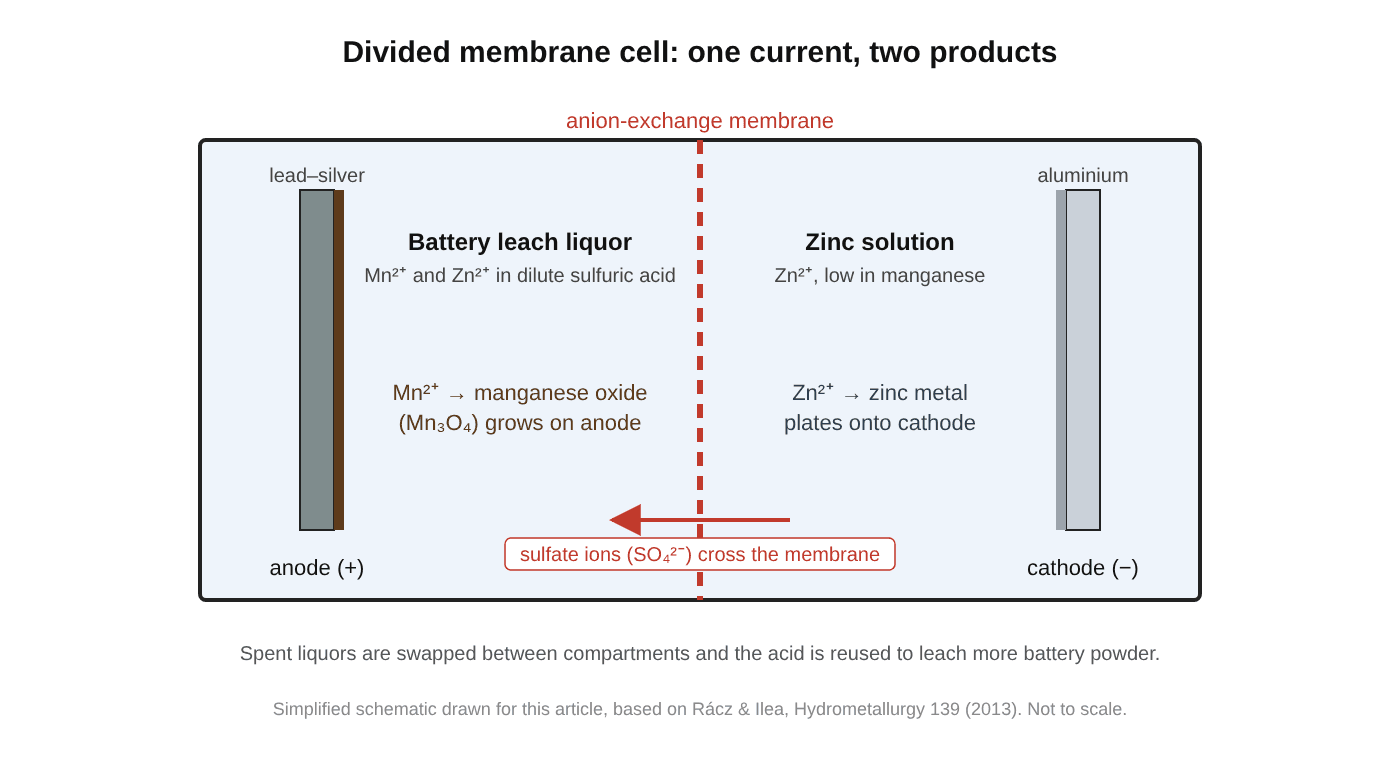
How the cell works. Manganese in the battery solution is oxidised to manganese oxide on the anode (left), while zinc plates out as metal on the cathode (right). The membrane keeps the two solutions separate but lets sulfate ions through.
Simplified schematic drawn for this article from the description in Rácz & Ilea, Hydrometallurgy 139 (2013). Not to scale.After a first run, the solutions were cycled. The spent anode-side solution, now rich in zinc but low in manganese, was moved to the cathode side for zinc recovery. The spent cathode-side solution was regenerated and reused as acid to dissolve more battery powder. The authors report recycling the solution in this way until 99% or more of the zinc and manganese ions had been recovered.
What came out
The team ran the cell at several current densities. The best balance was at 50 mA per square centimetre, where 85% of the anode current produced manganese oxide and 91% of the cathode current produced zinc.[1] The anode efficiency fell at higher currents. The authors state that these values are consistent with typical plant practice and equal to or better than earlier reports.
95%
Zinc extracted from battery powder by the acid leach
85%
Current efficiency for manganese oxide at 50 mA/cm²
91%
Current efficiency for zinc at 50 mA/cm²
≥99%
Zinc and manganese ions recovered after recycling the solution
The products were examined by X-ray diffraction, electron microscopy and elemental analysis. Both were phase-pure: the anode deposit was hausmannite, a form of manganese oxide with the formula Mn₃O₄, and the cathode deposit was zinc metal. The average crystal size was about 13 nanometres for the manganese oxide and 29 nanometres for the zinc. The paper notes that nanometre-scale manganese oxides of this kind have attracted interest as materials for lithium-ion batteries.
What this does and does not show
- What was demonstrated. At laboratory scale, manganese oxide and zinc metal were recovered simultaneously from spent zinc–carbon battery leach liquor in one membrane cell, with high current efficiency and phase-pure products, and the solution could be recycled within the process.[1]
- What the authors claim. The paper concludes that the route achieved recovery "with zero impact on the environment", with all electroactive, constructive and chemical parts recovered or returned to the process. This is the authors' assessment of their flowsheet at laboratory scale.
- What was not tested. The work does not demonstrate an industrial plant or continuous operation at scale.
Why it is on a neurotechnology site
This paper comes from a different field, but the skill at its centre carries straight across: controlling exactly what grows on an electrode surface by adjusting current, voltage and chemistry.
The same craft later shaped the tips of the jULIEs neural electrodes, which are coated with layers of nanostructured gold and iridium oxide grown by electrodeposition. The 2022 jULIEs paper explicitly cites earlier work by Rácz, Manciulea and Ilea (2011) on manganese dioxide electrosynthesis from spent battery leach liquors, when describing how nucleation centres form during deposition.[2] Read our guide to the jULIEs paper.
Who did the work
Romeo Rácz and Petru Ilea, Department of Chemical Engineering, Faculty of Chemistry and Chemical Engineering, Babeş-Bolyai University, Cluj-Napoca. Petru Ilea is the corresponding author.[1]
The work was supported by the Sectorial Operational Programme for Human Resources Development 2007–2013, co-financed by the European Social Fund, under project POSDRU/107/1.5/S/76841, "Modern Doctoral Studies: Internationalization and Interdisciplinarity".
Sources
- [1]Rácz R, Ilea P. Electrolytic recovery of Mn3O4 and Zn from sulphuric acid leach liquors of spent zinc–carbon–MnO2 battery powder. Hydrometallurgy 139:116–123 (2013). doi.org/10.1016/j.hydromet.2013.08.006
- [2]Rácz RR, Kollo M, et al. jULIEs (2022), reference 46: Rácz R, Manciulea A, Ilea P. Electrochemical behaviour of metallic titanium in MnO2 electrosynthesis from spent battery leach liquors. Stud. Univ. Babeş-Bolyai Chem. 56:211–22 (2011), as cited in the jULIEs paper. doi.org/10.1088/1741-2552/ac514f
How to cite the original work: Rácz R, Ilea P. Electrolytic recovery of Mn3O4 and Zn from sulphuric acid leach liquors of spent zinc–carbon–MnO2 battery powder. Hydrometallurgy. 2013;139:116–123. doi:10.1016/j.hydromet.2013.08.006
This article is not open access, so no figures from the paper are reproduced here. The diagram is a simplified schematic drawn for this summary from the paper’s description of its apparatus.
This summary is written for public understanding and is not medical advice.